Free PDF The Puzzle Instinct: The Meaning of Puzzles in Human Life, by Marcel Danesi
It can be among your early morning readings The Puzzle Instinct: The Meaning Of Puzzles In Human Life, By Marcel Danesi This is a soft documents book that can be survived downloading from online book. As understood, in this advanced age, technology will relieve you in doing some activities. Even it is just reviewing the visibility of publication soft documents of The Puzzle Instinct: The Meaning Of Puzzles In Human Life, By Marcel Danesi can be extra function to open up. It is not only to open up as well as conserve in the gadget. This time in the morning and also other spare time are to read the book The Puzzle Instinct: The Meaning Of Puzzles In Human Life, By Marcel Danesi
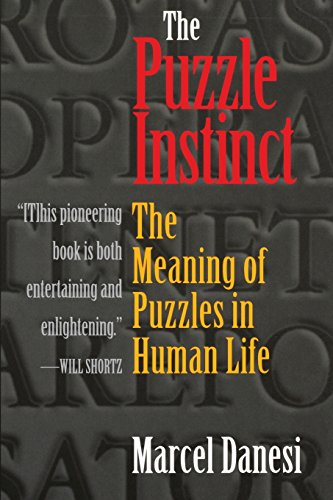
The Puzzle Instinct: The Meaning of Puzzles in Human Life, by Marcel Danesi

Free PDF The Puzzle Instinct: The Meaning of Puzzles in Human Life, by Marcel Danesi
Why must pick the trouble one if there is easy? Get the profit by getting the book The Puzzle Instinct: The Meaning Of Puzzles In Human Life, By Marcel Danesi right here. You will obtain different way making an offer and get guide The Puzzle Instinct: The Meaning Of Puzzles In Human Life, By Marcel Danesi As recognized, nowadays. Soft documents of guides The Puzzle Instinct: The Meaning Of Puzzles In Human Life, By Marcel Danesi end up being popular among the visitors. Are you among them? And right here, we are offering you the new compilation of ours, the The Puzzle Instinct: The Meaning Of Puzzles In Human Life, By Marcel Danesi.
Well, publication The Puzzle Instinct: The Meaning Of Puzzles In Human Life, By Marcel Danesi will certainly make you closer to what you want. This The Puzzle Instinct: The Meaning Of Puzzles In Human Life, By Marcel Danesi will certainly be constantly buddy any time. You may not forcedly to always complete over reading a book in brief time. It will be only when you have extra time as well as investing few time to make you feel enjoyment with exactly what you read. So, you can obtain the definition of the notification from each sentence in the publication.
Do you recognize why you need to review this website and also what the connection to reviewing e-book The Puzzle Instinct: The Meaning Of Puzzles In Human Life, By Marcel Danesi In this modern period, there are several methods to obtain guide as well as they will be a lot easier to do. Among them is by getting guide The Puzzle Instinct: The Meaning Of Puzzles In Human Life, By Marcel Danesi by on-line as what we inform in the link download. Guide The Puzzle Instinct: The Meaning Of Puzzles In Human Life, By Marcel Danesi can be a choice since it is so proper to your need now. To get guide on the internet is quite easy by simply downloading them. With this opportunity, you could check out the e-book wherever as well as whenever you are. When taking a train, waiting for checklist, and awaiting someone or other, you can read this online book The Puzzle Instinct: The Meaning Of Puzzles In Human Life, By Marcel Danesi as an excellent pal again.
Yeah, reading an e-book The Puzzle Instinct: The Meaning Of Puzzles In Human Life, By Marcel Danesi could add your friends checklists. This is just one of the formulas for you to be successful. As understood, success does not suggest that you have fantastic points. Comprehending and also understanding greater than other will certainly give each success. Beside, the notification and also perception of this The Puzzle Instinct: The Meaning Of Puzzles In Human Life, By Marcel Danesi can be taken as well as selected to act.
"Humans are the only animals who create and solve puzzles―for the sheer pleasure of it―and there is no obvious genetic reason why we would do this. Marcel Danesi explores the psychology of puzzles and puzzling, with scores of classic examples. His pioneering book is both entertaining and enlightening." ―Will Shortz, Crossword Editor, The New York Times
"... Puzzle fanatics will enjoy the many riddles, illusions, cryptograms and other mind-benders offered for analysis." ―Psychology Today
"... a bristlingly clear... always intriguing survey of the history and rationale of puzzles.... [A] splendid study...." ―Knight Ridder Newspapers
- Sales Rank: #1256278 in Books
- Published on: 2004-02-20
- Released on: 2004-02-20
- Original language: English
- Number of items: 1
- Dimensions: 9.25" h x .80" w x 6.12" l, .80 pounds
- Binding: Paperback
- 288 pages
Review
"Danesi, a professor of semiotics and anthropology (Univ. of Toronto), explores why puzzles, having arisen in earliest human history at the same time as mystery cults, are an intrinsic part of human life. Will Shortz, crossword puzzle editor of the New York Times, has suggested enigmatology as the study of the relationship between puzzles and culture. This book, which explores the puzzle genres that have survived over the years, is a contribution to that rubric. After first asking the question Why puzzles? (and developing several possible answers, among which is that they provide comic relief from unanswerable larger questions), Danesi devotes chapters to each of several types of puzzle. These include language puzzles (e.g., riddles and anagrams); pictures (e.g., optical illusions and mazes); logic (e.g., deductions and paradoxes); numbers (e.g., mathematical recreations); and games (e.g., chess). A final chapter synopsizes the discussion. A detailed list of references is included, as are solutions to the specific puzzles posed. The book is well written, has no mathematical prerequisites, and is quite suitable for a general audience as well as lower- and upper-division undergraduates." ―D. Robbins, Trinity College (CT), choice, December 2002
About the Author
Marcel Danesi is Professor of Semiotics and Anthropology at the University of Toronto and Director of the Program in Semiotics and Communication Theory. His books include Increase Your Puzzle IQ and Of Cigarettes, High Heels, and Other Interesting Things: An Introduction to Semiotics. He lives in Toronto.
Most helpful customer reviews
30 of 31 people found the following review helpful.
The Puzzle Is: Why Puzzles?
By Rob Hardy
Twenty-five years ago, there was a boom in sales of a fist-sized ingenious contraption of plastic, a fractured cube of multi-colored sides, the pieces of which could be twisted so that all the six faces had different colors (easy) or back to the one configuration where each face had only its own color (hard). The ubiquitous Rubik's Cube came and went (well, it is a puzzle classic in its simplicity; you can still buy it, but the fad is gone), but there will be some other puzzle fad not long from now. The urge to figure out puzzles seems to be as ingrained in human personality as the urge to make language or art. In _The Puzzle Instinct: The Meaning of Puzzles in Human Life_ (Indiana University Press), Marcel Danesi, a professor of semiotics and anthropology, tries to figure out the meta-puzzle: life has lots of mysteries and complications. Why should we want to manufacture more?
Danesi's book turns out to be a spirited review of puzzle history, and the history is a long one. The _Ahmes Papyrus_, nearly four thousand years old, is one of the earliest surviving documents of civilization anywhere, and is essentially a series of mathematical puzzles. It is significant that its title is _Directions for Attaining Knowledge of All Dark Things_. Charlemagne, the founder of the Holy Roman Empire, had a puzzle-maker on staff, and King Louis XIII of France had a Royal Anagrammatist. A description of Rubik's Cube is included, of course, as well as many other puzzle fads. The popularity of crossword puzzles is undimmed since they were introduced in the _New York World_ in 1913; the original one is reproduced here. Crosswords became an overnight sensation, and many people still have to do their crossword puzzle every day. Anyone familiar with puzzle literature will find much familiar here; classics like the Towers of Hanoi, magic squares (the best one is by Benjamin Franklin), the River-Crossing Puzzle, and various optical illusions are all included. The puzzle that gives us the exhortation "Think outside the box" is here, as is the four-color map theorem, Archimedes's Cattle Problem, cryptograms, and tangrams. No one reading this book could deny that making and solving puzzles is a universal human trait.
But why? Danesi finally comes to no certain conclusion, but there are some good reasons that he presents. One is that all of us enjoy the "Aha!" experience, the inexplicable flash of insight that can present an answer to something the likes of which we have never before encountered. Puzzles are escapism, but of a peculiar form invoking anxiety and curiosity after the puzzle is presented and pleasurably relieved only by finding the solution (or looking in the answer section). The most satisfactory answer is that like pure science, solving puzzles has been good for us. It is certainly true that working on puzzles is pleasurable, and can be instructive for the individuals trying to figure them out. In a larger sense (and this is a theme presented repeatedly here), puzzles have sparked mathematical revolutions. When Euler set out to solve the Königsberg bridge problem (citizens had known they could not walk around the river town crossing each bridge once and only once), he invented networks, and this eventually became topology. The paradoxes of Zeno (such as the runner being unable to reach the end of a race because he first has to go halfway, and then half of the remaining course, and then half of that, ad infinitum) were a spur for developing the concepts of limits and calculus. When Bertrand Russell tried logically to resolve his barber paradox (If a village barber shaves all and only those villagers who do not shave themselves, does he shave himself?), the resolutions themselves had paradoxes, and only Gödel's famous Incompleteness Theorem showed that full resolutions would be forever impossible. Puzzles are good for us, and this collection provides plenty to think about.
0 of 8 people found the following review helpful.
Other Books
By average
This is an overview of the origins of the puzzle in human history, as well as a more detailed look at the various types in existence, complete with some examples.
It also mentions some of the famous puzzle makers of history, and the influence of puzzles on mathematics and science and vice versa.
The Puzzle Instinct: The Meaning of Puzzles in Human Life, by Marcel Danesi PDF
The Puzzle Instinct: The Meaning of Puzzles in Human Life, by Marcel Danesi EPub
The Puzzle Instinct: The Meaning of Puzzles in Human Life, by Marcel Danesi Doc
The Puzzle Instinct: The Meaning of Puzzles in Human Life, by Marcel Danesi iBooks
The Puzzle Instinct: The Meaning of Puzzles in Human Life, by Marcel Danesi rtf
The Puzzle Instinct: The Meaning of Puzzles in Human Life, by Marcel Danesi Mobipocket
The Puzzle Instinct: The Meaning of Puzzles in Human Life, by Marcel Danesi Kindle

Tidak ada komentar:
Posting Komentar